- Meet the Team
-
Training Programs
- Acute Pediatric Congenital Cardiac Care Senior Fellowship Program
- Combined Triple Board Program
- Developmental Behavioral Pediatrics
- Fellowship in Pediatric Gastroenterology and Nutrition
- Global Health
- HMS Fellowship in Patient Safety and Quality
- Harvard Interprofessional Pediatric Palliative Care Fellowship (Physicians)
- Internal Medicine/Pediatrics
- Medical Biochemical Genetics
- Medical Genetics
- Medical Toxicology
- Pediatric Hematology/Oncology, Neuro-Oncology
- Pediatric Otolaryngology
- Pediatric Transplant Hepatology
- Pediatrics
- Pediatrics/Anesthesia, Medical Genetics
- Plastic and Oral Surgery - Paul Farmer Global Surgery Fellowship
- Surgical Fellowships
- Department of Urology Fellowship Training
- Adolescent Substance Use & Addiction Program Fellowship
- Adult Congenital Heart Disease
- Allergy and Immunology | Fellowship Training
- Pediatric Epilepsy
- Cardiac Imaging Senior Fellowship
- Cardiac Registry Senior Fellowship in Pathology of Childhood Heart Disease
- Pediatric Behavioral Neurology
- Child Neurology and Neurodevelopmental Disabilities Residency Training Programs
- Clinical Informatics Fellowship
- Complex Care Fellowship Training Program
- Congenital Cardiac Surgery International Fellowship
- Department of Anesthesiology, Critical Care and Pain Medicine | Residency and Fellowships
- Department of Dentistry | Pediatric Dental Residency Program
- Dermatology | Fellowship Program
- Division of Adolescent/Young Adult Medicine | Fellowship Training
- Pediatric Endocrinology Fellowship
- Division of Nephrology Fellowship Training Program
- Fellowship in Pediatric & Adolescent Gynecology
- General Academic Pediatrics Fellowship
- Harvard Neonatal-Perinatal Medicine Fellowship Training Program
- Harvard-wide Pediatric Health Services Research Fellowship
- Infectious Diseases Fellowship Program
- Interventional Cardiology
- Neonatal Neurocritical Care Fellowship
- Neonatal Neurology
- Neurological Surgery
- Neurosurgery International Fellowship
- Neurosurgery Shillito Fellowship
- Orthopedics
- Pediatric Brain Injury Medicine
- Pediatric Cardiac Critical Care Fellowship
- Pediatric Cardiac Surgery Fellowship Program
- Pediatric Cardiology
- Pediatric Electrophysiology
- Pediatric Emergency Medicine | Fellowship Program
- Pediatric Environmental Health Fellowship
- Pediatric Heart Failure and Transplant Fellowship
- Pediatric Hospital Medicine Fellowship
- Pediatric Movement Disorders & Neurogenetics Fellowship
- Pediatric Neurocritical Care Fellowship | Neurology Track
- Pediatric Ophthalmology Fellowship Program
- Pediatric Pathology
- Pediatric Pulmonology
- Pediatric Radiology
- Pediatric Registered Dietitian (RD) Residency
- Preventive Cardiology Senior Fellowship
- Pediatric Neuromuscular Disorders
- Pediatric Stroke
- Psychiatry Programs
- Rheumatology | Fellowship Program
- Surgical and Interventional Approaches to Pediatric Cerebrovascular Disease Fellowship
- Senior Fellowship in Exercise Cardiology
- Benefits & Support Services
- Diversity, Inclusion, and Health Equity
- GME On-Call Newsletter
- Verification of Training
Year 1 outline
The Boston Children’s CAP Fellowship is a traditional two-year fellowship, following three or four years of general (adult) psychiatry training, which is required for CAP Board Certification.
- 2 months: Inpatient Psychiatry Service
- 2 months: Emergency Psychiatry Service
- 4 months: Psychiatry Consultation
- 4 months: Outpatient Psychiatry Service

Sample Year 1 rotation block
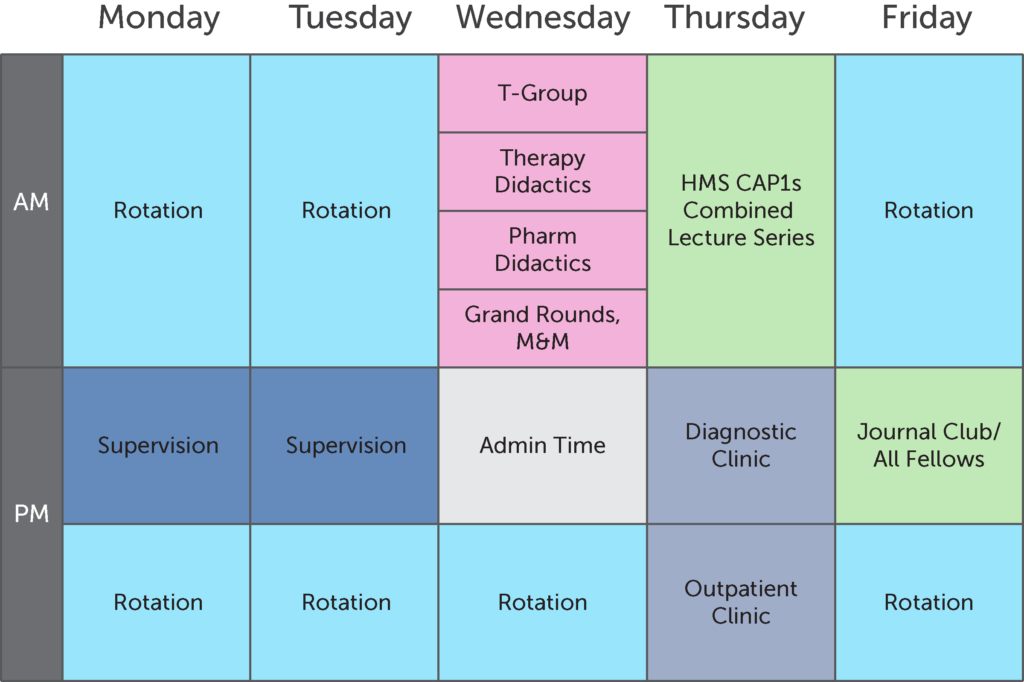
Inpatient Psychiatry Service and Emergency Psychiatry Service (IPS, EPS): The unique training goals of the IPS/EPS rotation are to teach fellows to evaluate and manage children, adolescents, and their families who present with severe psychiatric illnesses, or co-morbid medical-psychiatric illnesses, requiring acute care or care in a more restrictive inpatient setting. In this rotation, our fellows work collaboratively with a multidisciplinary team and are involved in all aspects of patient care, from family, to individual, to pharmacotherapy. During this block, fellows receive supervision from the medical director, the attending psychiatrists, and social work staff; rotation-specific didactics are also provided. The trainees also have the opportunity to provide supervision and peer mentoring to junior trainees in both IPS/EPS.
Psychiatry Consultation Service (PCS): The training goals of the PCS rotation are similar to those of IPS, but in a less-restrictive inpatient setting. Working on the interface between psychiatry and pediatrics challenges our fellows to refine their differential diagnostic and systems-management skills, as well as to develop and implement comprehensive treatment plans in a non-psychiatric milieu. During this four-month rotation, our fellows work closely with their attending PCS staff member to evaluate and follow patients during their medical hospitalization. Rotation-specific didactics are also provided.
Outpatient Psychiatry Services (OPS): The unique training goals of the OPS rotation are to teach fellows to conduct comprehensive evaluations, and to formulate and carry out related evidence-based treatment plans for children, adolescents, and their families who present with a wide range of psychiatric needs. Fellows perform clinical duties and train in a variety of outpatient settings: our Adolescent Substance Use & Addiction Program, Pediatric Neurology, Gender Multispecialty Service, ADHD Clinic, PCIT, an Autism Clinic, preschool consultation, and the Boston Children’s at Martha Eliot Community Health Center. Throughout the course of the first year, fellows maintain a continuity clinic one afternoon each week in the OPS. Attending supervisors review cases individually with each fellow in a traditional supervisory format; supervisors also directly observe and assist in select evaluations and/or follow-up appointments.
Year 2 outline
- Two to three sessions per week: Outpatient Psychiatry Services
- Two months: Inpatient Psychiatry Service
- Elective

Sample Year 2 rotation block
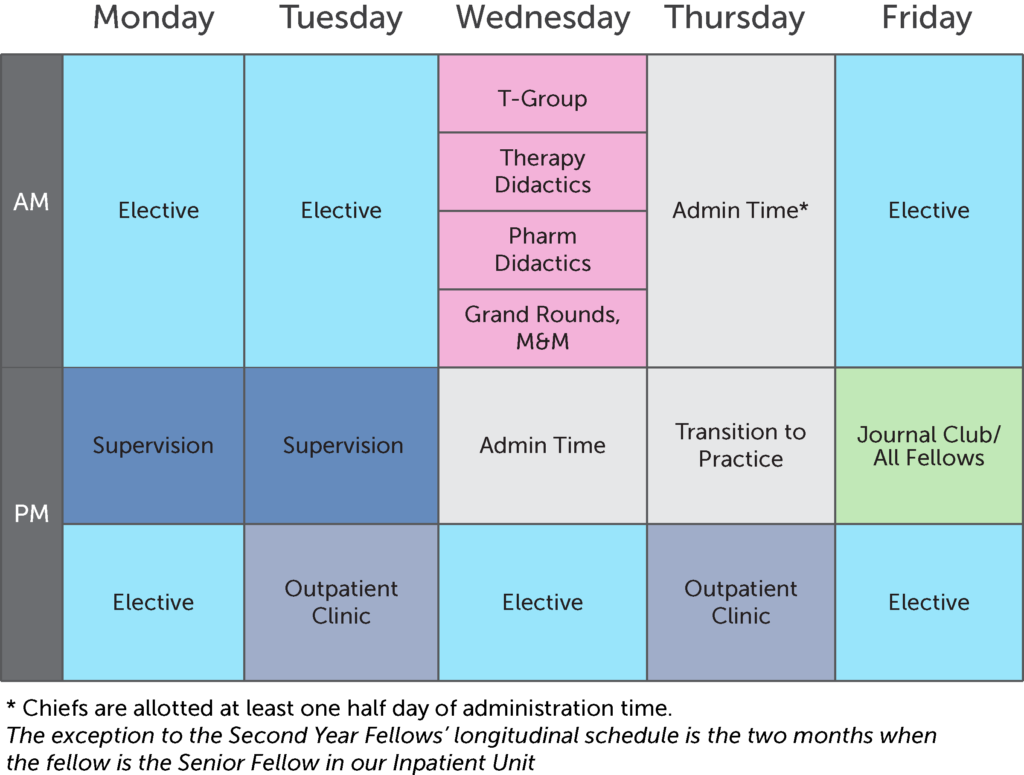
By the second year of training, we expect our fellows to show increasing autonomy and independence in their competencies as child psychiatrists, yet we continue to provide an experiential teaching model where senior staff are present and available on site to jointly see patients and families. The second year is designed to build upon the core skills and competencies required by ACGME, whilst also preparing them for graduation.
Given that the majority of the core training requirements are fulfilled during the first year of fellowship, one capstone of our program is that second-year fellows have ample time to pursue specific, individualized areas of interest. This allows our fellows to uniquely tailor a majority of their second academic year to meet their own clinical, academic, and professional goals.
Our second year of training is mostly made up of elective rotations; popular electives in the past have included: Pain Clinic, Sleep Clinic, Clinic for Interactive Media and Internet Disorders, PCIT Clinic, Harvard Medical School Behavioral Health Clinic, Young Adult Mental Health Clinic, Child Life Services rotation, Learning Disabilities Program, Asylum Clinic, Partial Hospitalization Clinic, and Pediatric Psychosocial Oncology, to name but a few.
On the Outpatient Psychiatry Service, second-year fellows increase their clinical time to three clinical sessions per week. Fellows broaden their developing skills of assessment, psychotherapy, and pharmacotherapy by working with a wider range of patients; supervisory structure is the same as that for the first year. During the course of the second year, each fellow also participates in a family therapy experience.
Both classes of fellows receive a forensic experience through participating in seminars and didactics, as well as family court visits, to become familiar with the Massachusetts legal system and matters related to the mental health needs of delinquent youth. They may also get further exposure through the Department of Youth Services in Massachusetts.